We study how the atomic structure of surfaces and interfaces shapes the behaviour of superconductors and molecules. Most of this work uses our low-temperature STM/AFM, described further down the page.
Materials for Quantum Technology
Superconducting quantum devices are limited by imperfections in their materials, such as defects and amorphous oxides, which collect at surfaces and interfaces. Reducing these imperfections improves device performance. We look for ways to limit oxide growth and to control the chemistry of the surfaces and interfaces in these devices.
For example, we found that titanium sacrificial layers reduce two-level-system (TLS) loss in tantalum resonators (Applied Physics Reviews, 2026). Using terahertz near-field microscopy, we also found that the boson peak, a spectroscopic signature of amorphous material, is concentrated at specific locations on tantalum films (J. Phys. Chem. Lett., 2023). We also test new substrates and growth methods, from ternary oxide substrates (Materials for Quantum Technology, 2022) to atomic layer epitaxy of superconducting titanium nitride (arXiv, 2026).
This work is supported by an ARC Linkage Project with IQM Quantum Computers and a collaboration with Arkady Fedorov’s SQD Lab at UQ.

Superconducting germanium
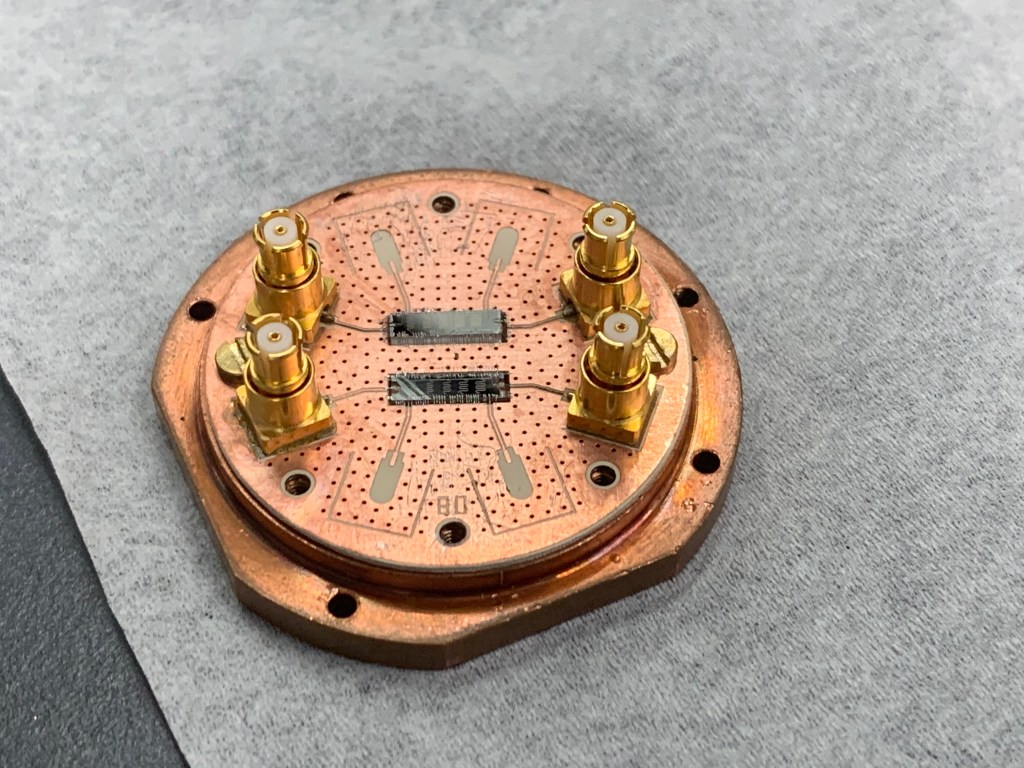
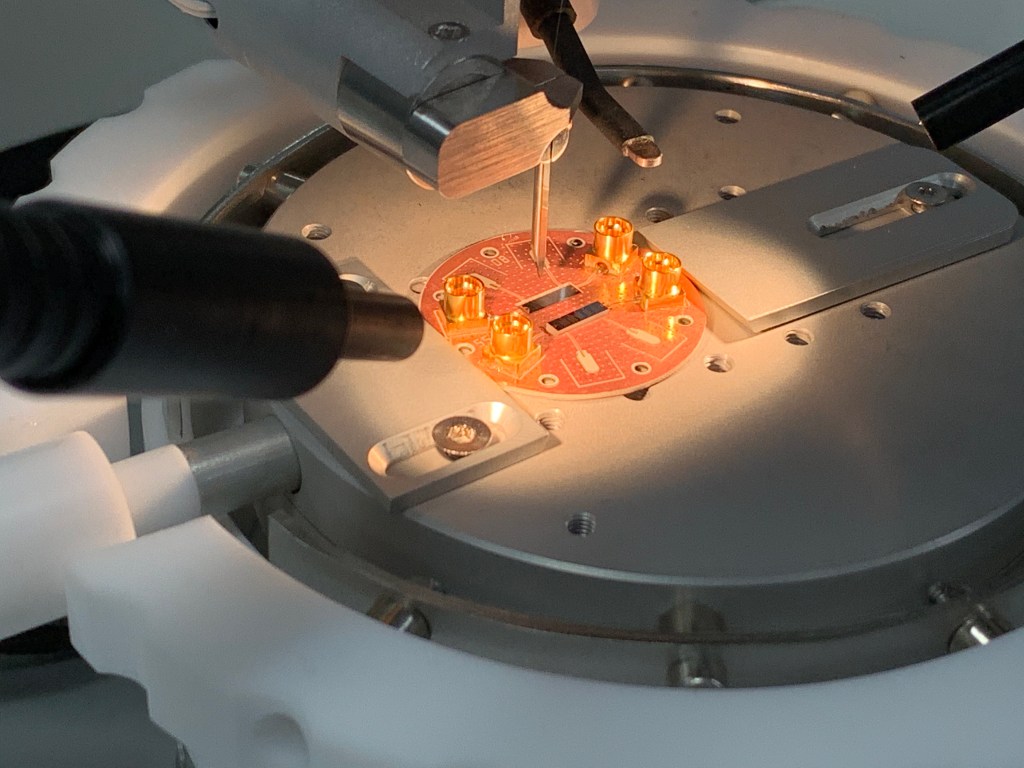
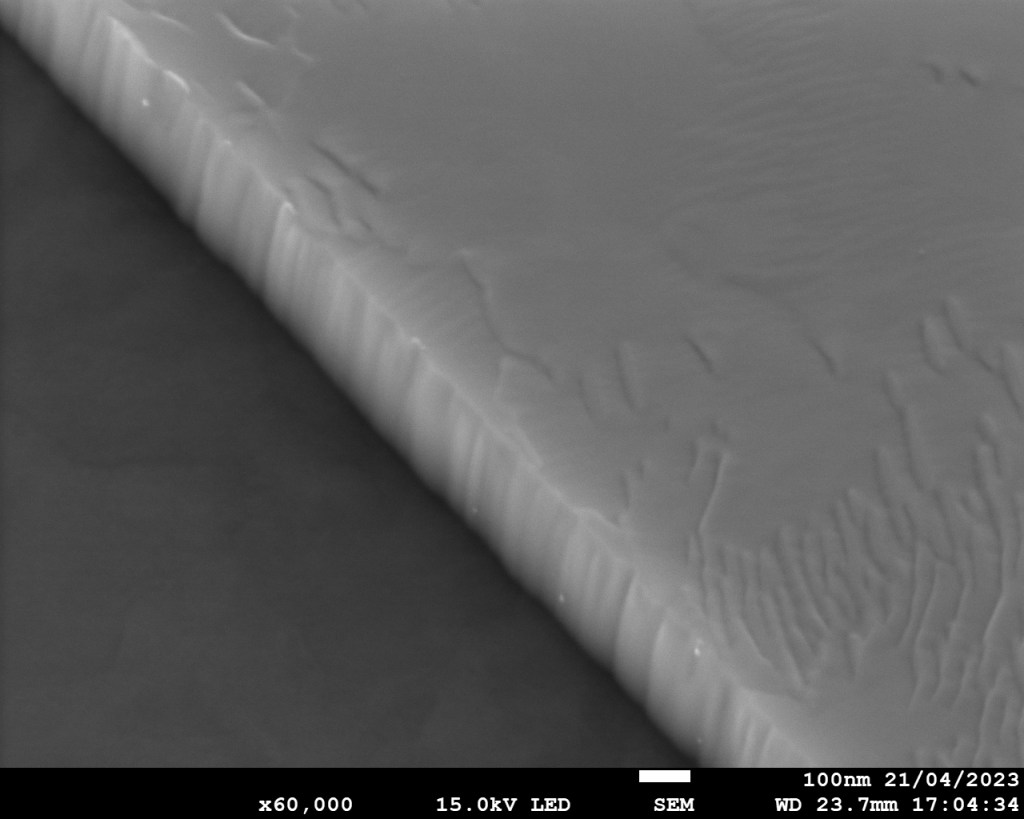
Germanium is a semiconductor, but when enough of its atoms are replaced by gallium it becomes a superconductor. Working with Javad Shabani’s group at NYU, who grew the films, and colleagues at UQ, Ohio State University and ETH Zürich, we showed that gallium-hyperdoped germanium grown by molecular beam epitaxy superconducts (Nature Nanotechnology, 2025). The work was covered by New Scientist and Physics World.
Because germanium is already widely used in electronics, superconducting germanium could make it easier to combine superconducting and semiconducting devices on one chip. We now want to see, atom by atom, where the gallium sits in the lattice and how superconductivity emerges.
Molecules on surfaces
Besides imaging single molecules on a surface, an STM tip can move them into new positions and sometimes trigger chemical reactions one molecule at a time. Through an ARC Discovery Project with Xiuwen Zhou (QUT) and Leonhard Grill (University of Graz), we study how organic molecules adsorb, move and react on surfaces. Recent examples include molecular motors (ACS Nano, 2023), and the way copper phthalocyanine molecules arrange in their first layer on indium oxide (J. Mater. Chem. C, 2025).
As part of the Quantum Decarbonisation Alliance, we are also imaging metal-organic frameworks, a class of materials studied for hydrogen storage, while theorists at UQ model the same systems using quantum algorithms.
Our instruments
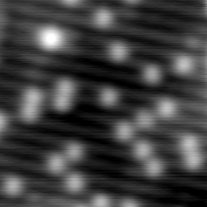
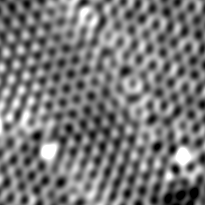
We use scanning tunnelling microscopy (STM) and atomic force microscopy (AFM) to image materials atom by atom and to measure their electronic structure. Our samples range from superconductors and semiconductors to oxides, 2D materials and organic molecules.
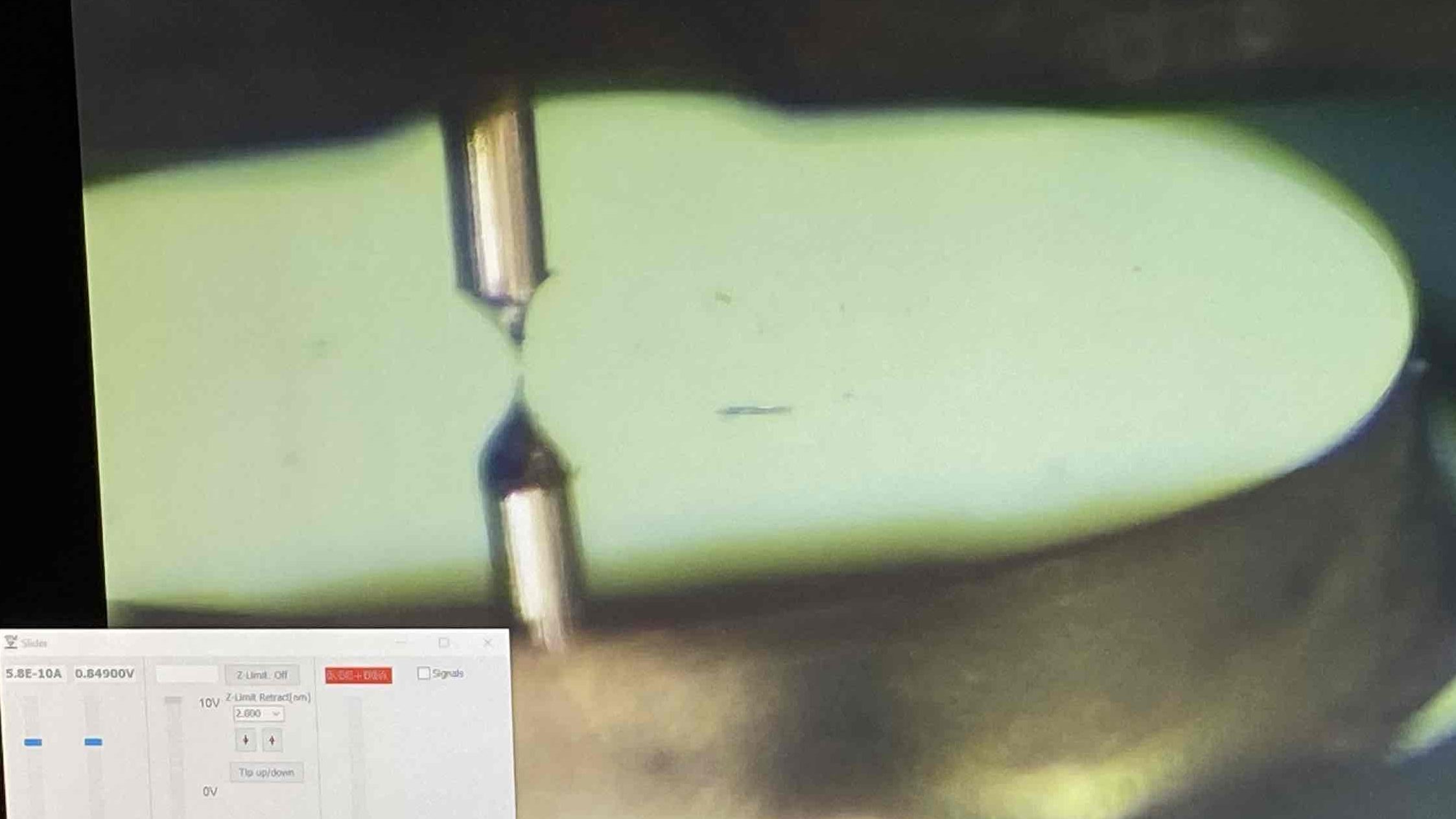
The centrepiece of our lab is Queensland’s first low-temperature scanning probe microscope, a Createc combined STM/AFM installed in 2022 and operating in ultrahigh vacuum (UHV). With a qPlus sensor, it can image a surface using either the tunnelling current or the force between tip and sample, which is measured as a shift in the sensor’s resonance frequency. UHV lets us prepare and image atomically clean surfaces. Cooling to 77 K or 5 K stops atoms and molecules from diffusing and sharpens the energy resolution of spectroscopy.

With Aleks Rakić (UQ Engineering), we also use scattering-type scanning near-field optical microscopy (s-SNOM) with terahertz light. It measures optical properties with a resolution of tens of nanometres, far below the wavelength of the light, and we use it mainly to study tantalum films and microwave resonators.
We also run experiments at large facilities, including the Australian Synchrotron, the ALBA synchrotron in Barcelona and ANSTO’s Australian Centre for Neutron Scattering.
Software
We write our own tools for handling scanning probe data. ProbeFlow, developed in the lab, opens data from Createc, Nanonis and RHK microscopes. It lets you browse images and spectra, apply processing steps reproducibly and export to common analysis formats. It is open source and free to download for macOS and Windows. We are now building on ProbeFlow to automate parts of STM operation.
Collaborators
We work with groups across Australia and overseas, including:
Arkady Fedorov (UQ SMP) – device fabrication and measurement
Julian Steele (UQ AIBN/SMP) – synchrotron GIWAXS
Javad Shabani (New York University, USA) – MBE material growth
Aleks Rakic (UQ Engineering) – THz SNOM
Carla Verdi (UQ SMP) – DFT calculations
Kirrily Rule, David Cortie (ANSTO) – neutron scattering
Dongchen Qi (QUT) – synchrotron photoemission, NEXAFS
Xiuwen Zhou (QUT) – DFT calculations
Leonhard Grill (Graz, Austria) – molecular manipulation
Craig Williams (UQ SCMB) – synthesis of organic molecules

